
That Sewage Smell in Your Yard Is Trying to Tell You Something
You step outside and catch that sharp, sour smell that doesn’t belong. Not garbage. Not compost. Something worse. Most people take a few steps, look around, and decide it must be coming from somewhere else.
It rarely is.
A sewage odor in your yard almost always has a source underground, and it’s usually your sewer line. The good news is that catching it early makes a real difference in what the repair ends up costing you.
Why a Healthy Sewer Line Doesn’t Smell
Your sewer line is a sealed system. It carries wastewater from the house to either the municipal connection or your septic system, and under normal conditions, none of that process should be detectable at ground level.
When sewage gases start escaping into your yard, something in that sealed system has failed — a crack, a loose fitting, a root intrusion, or a compromised joint. The smell is gas migrating upward through the soil. Sometimes the pipe itself is leaking waste. Either way, the yard is the symptom. The pipe is the problem.
The Most Common Cause: Damage Along the Line
Older pipes, especially clay or cast iron can crack over time. Soil shifts with temperature changes and moisture. Small movements accumulate. A pipe that held up fine for decades can develop a hairline fracture that slowly widens.
Early on, liquid may absorb into the surrounding soil without ever reaching the surface. You won’t see wet ground. You won’t see anything, really. But sewage gases don’t stay buried, and eventually they work their way up. That’s usually when homeowners first notice something wrong.
By the time the smell is obvious, the leak has often been active for a while.
Tree Roots Are a Bigger Problem Than Most People Expect
Roots search for moisture, and a sewer pipe even one with the smallest hairline crack offers exactly that. Once a root finds a way in, it doesn’t stop. It grows, branches, and keeps going until it’s either slowed the flow significantly or broken the pipe entirely.
A few signs that roots may be involved:
- Patches of grass that are noticeably greener or growing faster than surrounding areas
- Slow drains throughout the house, not just one fixture
- A sewage smell that lingers in the same general spot in the yard
- Soft or slightly sunken ground above where the sewer line runs
That greener grass is a reliable clue. Sewage is, unfortunately, a good fertilizer. A lush, bright patch in an otherwise normal lawn is worth paying attention to.
It Might Not Be a Break at All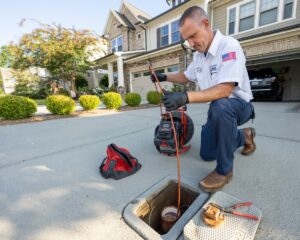
Here’s where it gets interesting. Some of the most alarming sewage smells turn out to have simple explanations.
A loose or cracked cleanout cap can vent gas directly into the yard. Venting issues inside the system can push odors backward and outward. A partial blockage can create enough back-pressure to force gas through weak points.
These situations don’t always come with wet ground, slow drains, or visible damage. The smell shows up and nothing else seems wrong. That’s actually a reason to investigate sooner rather than wait for other symptoms to confirm your suspicion.
Sometimes the fix takes twenty minutes. But you won’t know until someone looks.
What Rain Has to Do With It
If the smell gets noticeably worse after heavy rain, that’s a useful detail to give a plumber.
Saturated soil pushes gases upward more aggressively. A pipe that’s been leaking slowly for months might only produce a detectable odor when the ground is wet. Homeowners often describe it as seasonal or weather-related, and write it off.
It’s not random. The sewage problem was already there. Rain just made it harder to ignore.
Should You Be Concerned About Exposure?
Raw sewage contains bacteria and pathogens you don’t want in soil where kids play or pets dig around. The ground does filter some of it, but a long-term leak saturates the soil over time and that filtration capacity has limits.
It’s not a crisis situation if it’s been a day or two. It becomes a more pressing concern if the leak has been active for weeks or months, which is often the case by the time anyone calls a plumber.
How Plumbers Actually Find the Problem
Digging first is the wrong approach. Any experienced plumber should run a camera inspection before anything else.
A sewer camera is exactly what it sounds like a waterproof camera on a flexible cable that travels through the line. It shows cracks, root intrusion, collapsed sections, and buildup in real time. You see what’s there before any ground is broken.
That inspection changes everything. A visible root intrusion might be cleared without major excavation. A clean collapse of a six-foot section needs a targeted repair. Without the camera, you’re guessing and guessing underground gets expensive fast.
Questions Worth Asking
Why does the yard smell like sewage but nothing seems wrong inside the house?
If there’s no backup, no slow drains, and no odor indoors, the issue is likely along the buried portion of the line. The waste isn’t reaching the house it’s escaping before it gets there.
Could this be coming from a septic system instead?
Yes. A failing septic tank or drain field produces a very similar odor. If your property uses a septic system, that’s worth checking alongside the main sewer line.
Will the smell eventually go away on its own?
Occasionally it fades temporarily, especially if conditions change. But it usually returns, and the underlying issue doesn’t resolve without repair.
How urgent is this, really?
That depends on the cause. A loose cap is an afternoon fix. A cracked pipe leaking into the soil for months is more serious. The only way to know where you fall on that range is an inspection.
What should I tell the plumber when I call?
Describe where in the yard the smell is strongest, whether it changes after rain, and whether you’ve noticed any drain slowdowns inside. That context helps narrow the inspection.
If you’re smelling sewage outside, the source is almost certainly underground and it’s worth finding out what’s actually happening before the problem gets larger. A camera inspection is fast, relatively inexpensive, and tells you exactly what you’re dealing with. That’s a much better starting point than waiting to see if it gets worse.